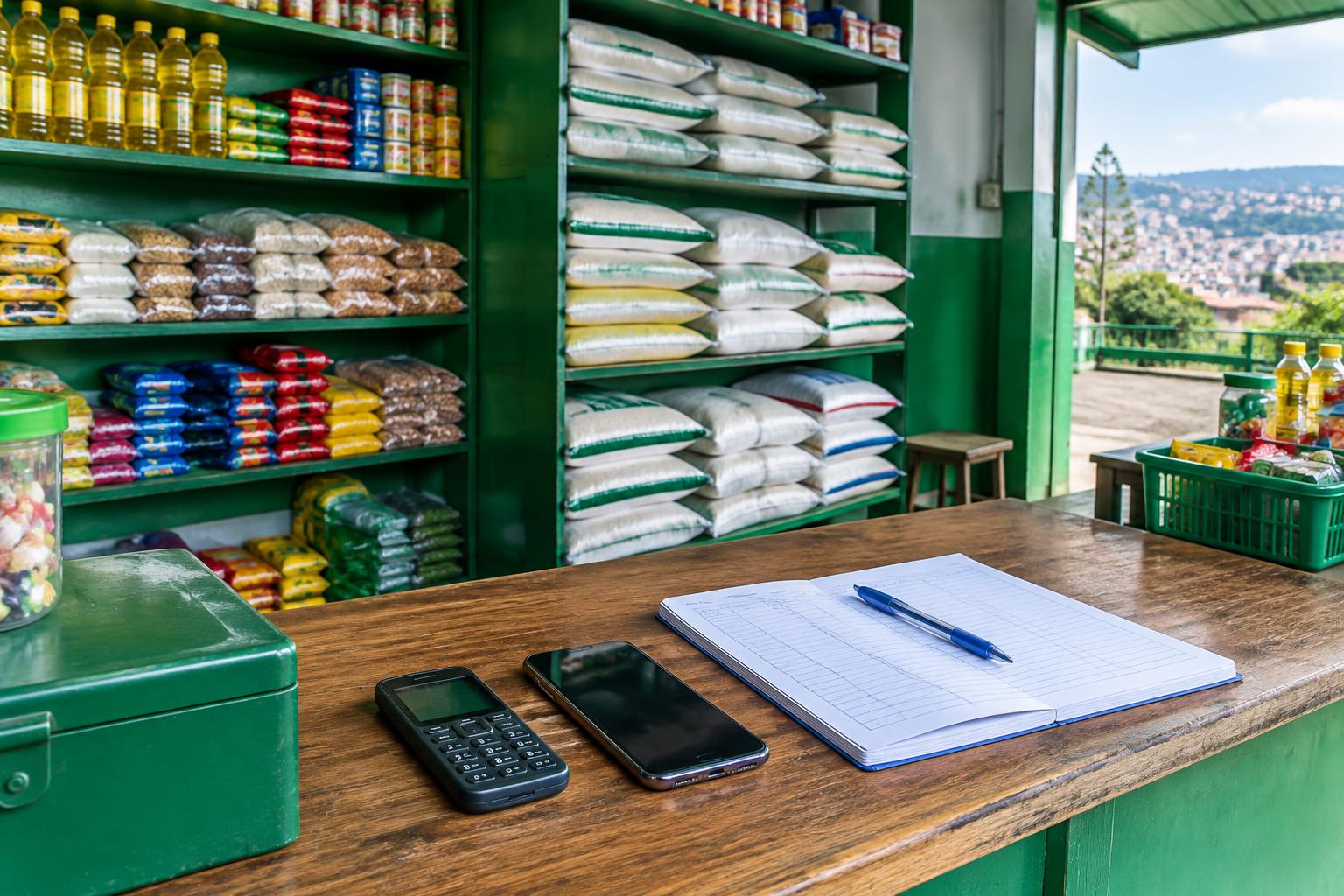
01 / Register, choose a language, learn the flow
Proposed onboarding begins by verifying the merchant’s identity, business details and applicable fiscal status. The merchant selects English, Kinyarwanda, Kiswahili, French or Arabic and receives a clear explanation of data use. Support staff should demonstrate a simple sale and explain the difference between a saved record and an authority-accepted receipt.
No dedicated app or physical fiscal terminal is assumed for SMS and proposed USSD access. A working phone, a provisioned channel and an authorized merchant identity are still necessary. Telecom costs, short codes and customer-support arrangements must be agreed before rollout; the illustrative USSD code shown here is not an active service number.
02 / Describe the sale in a familiar message
A merchant sends the item, quantity and unit price, for example three bags of rice at 15,000 RWF each. The system interprets the message, validates the arithmetic and returns a structured summary. When a price or quantity is unclear, the production workflow should ask for clarification. It must never invent a missing amount or official tax code.
SMS supports a concise exchange; chat channels can carry a richer receipt response and QR image; USSD guides the merchant through short prompts within a timed session. All channels should converge on the same sales record. The simulator currently demonstrates extraction and automatic illustrative classification, while live USSD and telecom routing remain partner integration work.
03 / Match wallet payments without double counting
Mobile Money and Digital Wallet partners send payment events through contracted, authenticated interfaces. A successful event is matched to the sale by its reference, amount and currency. It updates payment evidence but does not itself create authority acceptance. Cash sales must remain possible as a separate payment category where permitted by the merchant’s fiscal rules.
Repeated callbacks must be deduplicated using a stable event identity. A reversed, failed or unmatched payment goes to reconciliation rather than generating another sale. Partner agreements should define callback signing, retry schedules, outage handling and dispute escalation. The integration inspector lets teams explore these states with explicitly simulated events.
04 / Deliver receipts and close the day
The receipt view groups sale lines, totals, tax treatment and verification identifiers. A QR code points to a lookup, but a scannable QR alone does not prove RRA approval. A production receipt must display the real authority acceptance and required identifiers only after certified processing. Current receipts and their verification records remain clearly simulated.
At the daily close, review sales in Africa/Kigali time, compare cash and wallet evidence, and investigate unmatched events. The merchant workspace exports a complete CSV register and an informational Z-report. If connectivity fails, preserve the event reference and reconcile after reconnection; do not resend the same sale as a new transaction simply because the reply was delayed.